
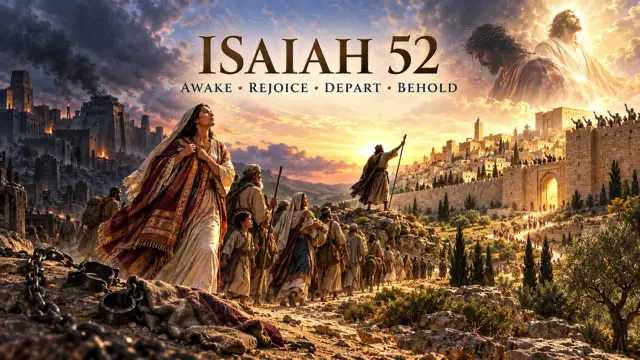
God calls Zion to awaken because He is coming to redeem, restore, and reign; therefore, His people must leave captivity in holiness and proclaim the good news, while looking to the exalted yet suffering Servant through whom redemption comes.
V 1-2 Awake: God will restore Zion’s dignity Zion (Israel/Jerusalem) is commanded to awaken and put on strength and beautiful garments. Jerusalem will no longer remain humiliated and defiled.
The captive daughter of Zion must rise, shake off the dust, and remove the chains from her neck. This was spoken to the captives in Babylon who will soon be set free to return to Jerusalem and Israel under the protection of Cyrus.
God’s redeemed people must live in the freedom and identity He has given them. They were in captivity because of their idolatry and sins, but Israel will forever be God’s firstborn among the nations.
V 3 God will redeem His people for His name’s sake – Israel was sold for nothing and will be redeemed without money.
God had not sold Judah to pay a creditor; He gave her over by His own will and could redeem her by that same will. The matter was solely between God and His people.
V 4-6 God will judge Egypt, Assyria, and Babylon who oppressed Israel and blasphemed God’s name. He will bring them out from the nations where He sent them and rescue His people. Thus, He will reveal to them that He has been with them in their distress.
Here and in Ezkiel 36:16 ff, God through His prophet describes that their oppression and taunts because of his discipline on them caused God’s name to be continually blasphemed. So, God promises that His people will know His name and recognize that He Himself has spoken and acted.
Israel’s redemption depends not on human payment or works, but on God’s faithfulness to His name and covenant.
V 7-10 Rejoice: God returns to Zion as King The messenger’s beautiful feet symbolize the welcome arrival of the good news of peace, salvation, and God’s reign over Israel. The Hebrew expression for “good news,” translated “gospel” in the Septuagint and New Testament, carries a royal emphasis: the gospel announces that God is King.
The messenger is not specifically named. He is a herald who brings news to Zion that the exile is ending, salvation has come, and “Your God reigns. In its immediate context, the messenger represents those who announce Judah’s return and God’s restoration of Jerusalem.
In the New Testament, Paul applies the verse more broadly to those who proclaim the gospel of Messiah (Romans 10:15). Thus, the messenger is any God-sent herald announcing the good news of God’s saving reign.
In v 8 in its original context, Zion’s watchmen are Israel and Jerusalem’s God-appointed proclaimers of Israel’s restoration. Prophetic observers awaiting Israel’s redemption who rejoice together as they see the Lord restoring Jerusalem and bringing His exiled people home.
While the messenger announces the good news, the watchmen recognize its fulfillment approaching. Today, Israel’s remarkable regathering as outlined in Ezk 36, to the land may be viewed as a preliminary fulfillment and a sign that God remains faithful to His prophetic promises. While the passage ultimately points to Israel’s complete restoration when the Lord returns to Zion to rule and reign it just may be that the beginning of this fulfillment is taking place in our day.
Jerusalem’s ruins recall Paul’s words in Rom 8:22 “For we know that the whole creation groans and suffers the pains of childbirth together until now.” The stones cry out and are commanded to sing because God has comforted and redeemed His people. This is a response in praise how God reveals His holy arm before all nations, as the ends of the earth see His salvation.
The heart of the good news is, “Your God reigns.”
V 11-12 Depart: God calls Israel to leave Babylon in purity, abandoning its idolatrous practices rather than carrying them back to Jerusalem. Unlike fugitives, the returning Israelites will not need to flee in fear or haste, because the Lord will lead and protect them from front and rear (v. 12).
This return from Babylon also anticipates the greater, ultimate restoration of Israel described throughout Isaiah 51–52.
Redemption calls God’s people to holiness and gives them confidence in His protecting presence.
V 13-15 God’s Servant will be exalted through suffering – At the heart of Isaiah’s deliverance prophecies is the fourth Servant Song, which presents the Servant-Messiah as the sacrifice for Israel’s redemption.
Isaiah 42 describes His responsibilities, Isaiah 49 His mission, and Isaiah 50 His rejection; Isaiah 52:13–53:12 brings His work to its climax. Through His sacrifice, the Servant provides redemption for Israel and extends salvation to the world.
The poem consists of five three-verse stanzas. The opening (52:13–15) and closing (53:10–12) form a prologue and epilogue in which God speaks of the Servant’s exaltation. In the three central stanzas (53:1–9), repentant Israel reflects on His humiliation, suffering, and death.
Ancient Jewish interpretation frequently identified the Servant as the Messiah. For example, Targum Jonathan renders Isaiah 52:13, “Behold, My Servant the Messiah shall prosper,” and the Babylonian Talmud also connects the passage with Messiah (Sanhedrin 98b). The influential medieval commentator Rashi, however, identified the Servant corporately as Israel, an interpretation followed by many later Jewish interpreters and scholars.
The Servant will act wisely and be raised, lifted up, and highly exalted. Before His exaltation, His appearance will be shockingly disfigured. Through His suffering, He will “sprinkle” many nations, language associated with cleansing and priestly atonement. Kings will be silenced as they behold a work of God they had never understood.
Emphasis: God’s worldwide salvation will come through the suffering and ultimate exaltation of His Servant.
Isaiah 52 describes how God wakens His remnant through His Word and His Spirit about His promise of redemption, announces His reign, and calls His people to holy separation from Babylon, and finally reveals the Servant who accomplishes salvation.