Isaiah 47 — “Babylon Brought Down: The Redeemer Alone Is King”
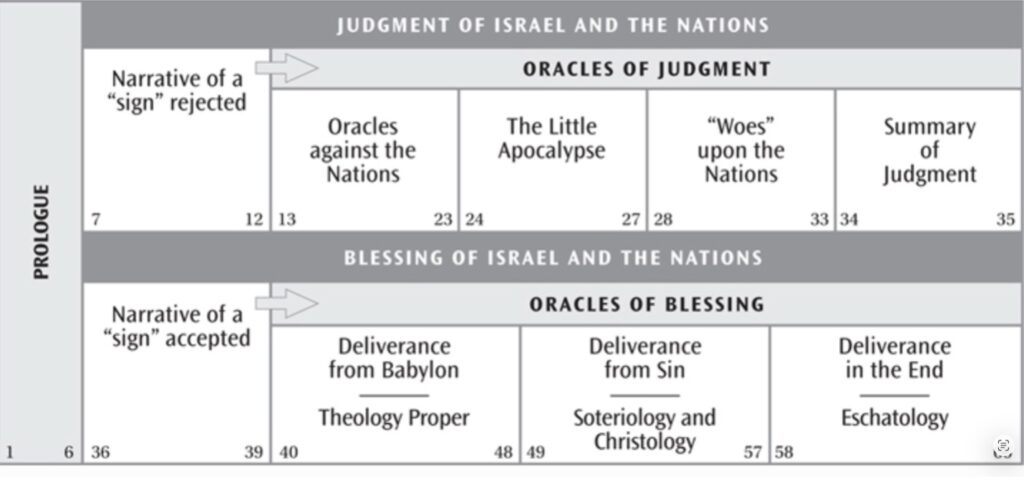
Here is a excellent chart that my friend Michael Rydelnik put together giving an over all perspective of Isaiah
Isaiah 47 announces the humbling of Babylon and God’s deliverance of His people. It prophecies further concerning Babylon’s fall and Israel’s release from captivity. It also reveals the spiritual nature of “Babylon” as human power, pride, idolatry, the occult, wealth and independence from God. This would be accomplished in Yeshua at His first coming. The redemption He provided frees us from the dominion of the power and spirit behind Babylon, and at His second coming He will bring the final Babylonian world system to judgment.
The transition into this chapter began in Isaiah 39 when Hezekiah displayed Judah’s treasures to Babylon’s emissaries. Isaiah tells him that a day is coming when those treasures and some of his descendants will be carried to Babylon. Then in chapter 40 God gives this wonderful word to His people “Comfort, O comfort My people,” says your God. Isaiah 40:1.
Chapters 40–48 explain how God will redeem Israel from the Babylonian captivity.
Isaiah 44–45 identifies Cyrus as God’s chosen instrument. God calls Cyrus His “anointed” (“messiah” in 45:1) not because Cyrus is the promised Messiah, but because God appoints him to accomplish the deliverance of His people from Babylon.
Isaiah 46 then announces the humiliation of Babylon’s gods, Bel and Nebo. The Babylonians had to carry their gods, while the God of Israel carries His people.
Isaiah 47 turns from Babylon’s gods falling to the defeat and overthrow of the nation. Isaiah 48 concludes the section by telling Israel to “Go forth from Babylon! Flee from the Chaldeans!” Isaiah 48:20.
V 1–4 In v 1 Babylon is personified as a beautiful young woman. “Come down and sit in the dust, O virgin daughter of Babylon.” She had sat on a throne. Now God tells her, “Your throne is gone. Sit in the dirt.” She is further humbled by her doing what servants did for her – grinding flour. Her luxurious garments are removed and her shame is revealed. This is an ongoing theme throughout scripture a great reversal to those who are the enemies of God’s chosen people.
Babylon is not defeated because Persia is stronger but because of Israel’s Redeemer. The Hebrew word is גֹּאֲלֵנוּ — go’alenu, “our Redeemer” and it comes from the Hebrew word go’el, kinsman-redeemer who acts on behalf of a relative who cannot rescue himself. This title has already been revealed in Isaiah: “The LORD your Redeemer” 43:14; “His Redeemer, the LORD of hosts” 44:6 “Your Redeemer” 44:24.
And in Isaiah 40–55 the question is how deep is Israel’s redemption to be? Cyrus can rescue Israel from Babylon. But Cyrus cannot rescue Israel from sin. That requires the work of God’s Servant who appears in chapters 49–53 pointing to the true Messiah of Israel.
V 5–7 – God says: “I was angry with My people, I profaned My heritage and gave them into your hand.” Babylon’s victory of Judah was not evidence that Babylon’s gods had defeated the God of Israel. But rather God says: “I gave them into your hand.” Babylon was used by God to provide God’s discipline.
Though they were raised up by the Lord they are not guiltless. The Lord condemns them with these words here: “You did not show mercy to them.” Babylon acted in their free will and will be held accountable. God’s permissive will does not relieve us of the consequences for our sins. Babylon fulfilled a role within God’s providence, but she acted with cruelty, arrogance and harshness and as such is held accountable.
In Midrash Tanchuma, a Jewish commentary on this passage which interprets 47:6 beyond Babylon as a principle of divine judgment on later oppressive empires. Writing that when God permits a nation to exercise power over His people it does not give them permission to treat them without mercy. God may use nations. But God also judges nations for how they use the power He permits them to possess.
Babylon thought of herself “I shall be a queen forever.” In v 7. She thought herself untouchable by her enemies. Every empire begins to believe that their dominance is permanent. But Isaiah and history remind us that no kingdom is permanent.
V 8-11 – Babylon believes she is God. “I am, and there is no one besides me.” In v 8 & 10. This follows God’s Word “I am the LORD, and there is no other.” In v 5. Babylon has taken God’s language and applied it to herself. God says: “I am, and there is no other.” While Babylon says: “I am, and there is no one besides me.” This is the Babylonian worldview throughout Scripture the spirit of world claiming to sit on God’s throne.
This worldview began at Babel in Gen. 11:4 “Let us build for ourselves a city… and let us make for ourselves a name” (Genesis 11:4). The same spirit culminates in Revelation. Babylon also says: “No one sees me” In 47:10. Essentially, she is saying “There is no God to whom I will ever have to answer.”
Rashi the medieval Jewish commentator writes Babylon’s “wisdom and knowledge,” coupled with the evil inclination of her heart, perverted her and turned her away from the proper path. Their problem was not ignorance since they had extraordinary knowledge. It was knowledge separated from submission to God.
V 12-15 Isaiah invites Babylon to call their astrologers and counselors to save them. If these powers really control history, let them stop what I have decreed. Again, the Rabbinical commentators write that Isaiah is mocking Babylon’s knowledge of sorcery and astrology that claim to foresee what is coming and are unable to prevent their own destruction.
Verses 4 & 15 display a significant comparison: In v 4 we learn of Israel’s Redeemer with v 15 “There is none to save you.” Israel has a Redeemer and though Babylon has many counselors, gods, magicians, merchants and astrologers they are without a savior. This is a contrast that runs throughout Isaiah 40–48.
To those who heard this they would have been stunned by these prophecies. He spoke in the day when Assyria was the superpower intimidating all their surrounding nations. Babylon had not yet ascended in power but in chapter 39 Isaiah announced that it would be Babylon and not Assyria who would bring Jerusalem and Judah into captivity.
Isaiah’s words in chapters 40–48 allow Isaiah’s audience to see that terrifying Assyria who had just crushed Israel to the North would not be the one to end the independence of Israel. Nor would even Babylon be the end of Israel. He saw their captivity but also saw Israel’s Messiah coming first as a lamb and then later as a lion. Bringing the hope of Israel to that nation first, then to the nations and then fully restoring Israel to her land and calling as priests to the nations. This message should speak to us today with the word that we should not judge God’s faithfulness by the power or powers presently dominating the world. Assyria then looked invincible, but it was not. So too Babylon looked invincible, followed by Medio Persia, followed by Greece, then Rome and all its successors. They all fell before the Rock of Israel as Daniel saw in his vision in Daniel 2:34–35; 2:44–45.
In Nebuchadnezzar’s dream, Daniel describes a stone “cut out without hands” striking the statue’s feet, crushing the kingdoms represented by the statue. The stone then becomes a great mountain filling the earth. Daniel interprets it as God establishing an everlasting kingdom that will crush and end all other kingdoms. Israel’s and our future rests in the Holy One of Israel, Israel’s Redeemer.
Isaiah 47 contributes to an unfolding word of God pointing to the redemption that is to be revealed in the Servant. He in his prophetic writings asks and answers the question of what kind of redemption Israel needs.
Cyrus can release Jewish captives, but he cannot bear Israel’s sins. Cyrus fades while the true deliverer rises. Isaiah 49:1 tells us: “The LORD has called Me from the womb.” And that “He would be pierced through for our transgressions.” Isaiah 53:5. This would be the first-coming where Yeshua would confront the deeper power represented by Babylon, sin, idolatry, Satanic domination and death itself. The first coming is the for their redemption. The second coming will provide judgment and the rule of God on earth as it is in heaven.
Isaiah 47 also reveals also the Second Coming of Yeshua and is clarified in the Book of Revelation. Isaiah’s Babylon says: “I will be a queen forever.” 47:7 and in v 8 “I will not sit as a widow.” Revelation 18:7 says “I sit as a queen and I am not a widow.” Isaiah says Babylon’s calamity will come suddenly, including loss and widowhood (47:9–11). Revelation 18:8 says her plagues will come “in one day.”
John saw Babylon as a model of something larger: the world system organized in defiance of God. Its economic power, religious corruption, luxury, persecution and pride culminate in the “Babylon” of Revelation 17–18. And Isaiah’s verdict becomes the same as Revelation’s verdict: Babylon will fall. Then Revelation 19 reveals the appearing and triumph of Messiah.
Isaiah 47 warns us that we should be careful not simply to identify Babylon with whichever nation or political system we presently dislike. Scripture’s application is much more searching than that. Babylon is first something we must recognize in ourselves.
The chapter exposes several manifestations of the Babylonian spirit: confidence in wealth and comfort; belief that present security will continue indefinitely; exploitation of weaker people; obsession with controlling or predicting the future; reliance upon human wisdom apart from God; secret sin accompanied by “no one sees me”; and ultimately the attitude, “I am, and there is no one besides me.”
Today men will not knowingly bow before Bel and Nebo. But the world tells us that we determine who we are defines what is true. We are told that we control our destiny. This is the Babylonian world view. The gospel calls us to an opposite perspective. Babylon says: “I am.” Faith says: “He is.” Babylon says: “I need no one.” Faith says: I need thee every hour. Babylon says: “No one sees me.” Faith says: “You are the God who sees.” Babylon searches everywhere for someone to save her. Israel declares “I have a Redeemer”.
The Central Message of Isaiah 47 is the revelation between Cyrus the temporary deliverer and the Servant who becomes the ultimate Redeemer. Cyrus defeated historical Babylon. Yeshua defeats the deeper enemies that Babylon represents.
And when Yeshua returns, the cry anticipated in Isaiah will become universal: Babylon has fallen, and the true King reigns. The great question Isaiah 47 leaves us with is not merely, “What happened to Babylon?” It is instead where am I placing my confidence while I wait for the return of my Redeemer?
Every throne built apart from God eventually will bow before the Rock of our Salvation whose Kingdom will never fall.